The Great Decoupling: How AI Agents are Redefining the 24-Hour Workday
SAN FRANCISCO – The landscape of professional productivity is undergoing its most significant shift since the Industrial Revolution. While 2024 was defined by the novelty of "chatting" with AI, 2026 has become the year of the Autonomous Agent. We are no longer just talking to machines; we are delegating entire lifecycles of projects to them.
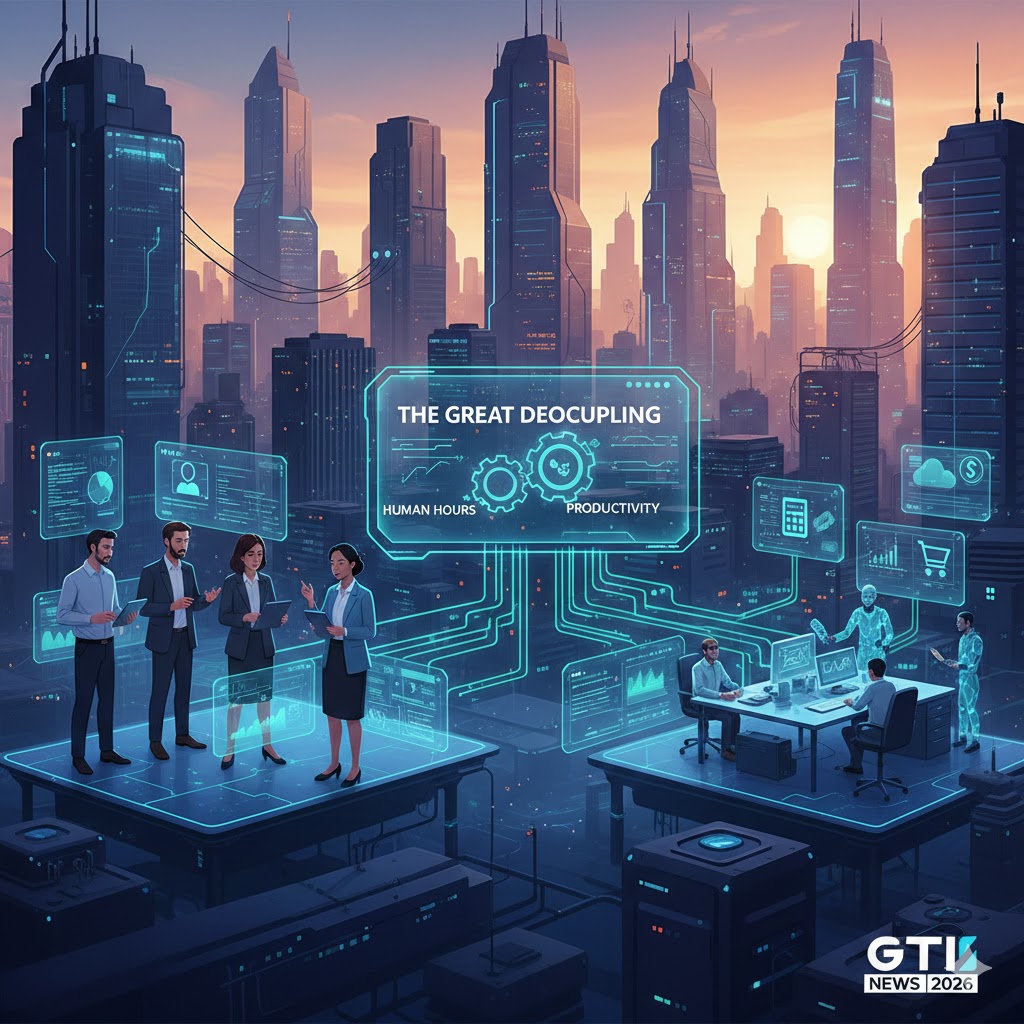
As organizations grapple with this transition, the "Great Decoupling"—the separation of productivity from human hours worked—is moving from a theoretical concept to a corporate mandate.
The Rise of the "Invisible Colleague"
In the past twelve months, the deployment of specialized AI agents has surged by 140% across Fortune 500 companies. Unlike standard chatbots, these agents possess "long-term memory" and the ability to navigate across software platforms independently.
Task Autonomy: Agents can now book travel, reconcile invoices, and update CRM entries without human oversight.
Inter-Agent Communication: Marketing agents are now "negotiating" directly with supply chain agents to adjust ad spend based on real-time inventory levels.
Contextual Awareness: Modern systems understand company culture and "tone of voice," ensuring that automated client outreach feels personal rather than robotic.
"We are moving away from a world where humans use tools, to a world where humans manage digital ecosystems," says Dr. Aris Thorne, Lead Researcher at the Global Tech Institute. "The bottleneck is no longer the speed of typing, but the clarity of intent."
Economic Implications: The Productivity Paradox
Despite the efficiency gains, economists are observing a strange phenomenon. While output per worker has spiked, the "burnout index" remains at an all-time high. This suggests that instead of using AI to reclaim time, businesses are simply filling the saved hours with more complex, high-pressure strategy sessions.
| Sector | Productivity Increase (YoY) | Primary Driver |
|---|---|---|
| Software Dev | 65% | AI-assisted debugging & refactoring |
| Customer Service | 80% | Autonomous resolution bots |
| Legal Services | 40% | Automated discovery and contract review |
| Creative Arts | 25% | Rapid prototyping and asset generation |
The Ethics of Autonomy: Who is Responsible?
As agents take more control, the legal framework is struggling to keep pace. When an autonomous procurement agent makes a billion-dollar error in a "flash crash" of automated bidding, where does the liability lie?
The Developer: Is the code inherently flawed?
The User: Did the prompt lack sufficient guardrails?
The Model Provider: Is the underlying logic biased or hallucinating?
Current legislative efforts in the EU and the US are focusing on "Human-in-the-loop" (HITL) requirements for high-stakes decisions. However, the sheer speed of AI operations often makes human intervention a symbolic gesture rather than a practical safety net.
Redefining the "Entry-Level" Role
The most profound impact is being felt by recent graduates. Traditionally, entry-level roles involved the "grunt work"—data entry, basic research, and scheduling. These are precisely the tasks AI agents handle best.
The Skill Shift: Universities are pivoting from teaching how to do a task to how to audit a task done by an AI.
The Mentorship Gap: If juniors aren't doing the basic work, how do they gain the foundational experience needed to become seniors?
The Rise of the "Generalist": Success in 2026 favors those who can speak the languages of both technology and business strategy.
"I don't hire coders anymore," claims Sarah Chen, CEO of NexaStream. "I hire architects who can direct an army of digital coders. The fundamental skill of the decade is Critical Evaluation."
Looking Ahead: The Post-App Era
Industry insiders predict that by 2027, the concept of an "app" will be obsolete. Instead of opening a specific program like Excel or Photoshop, users will simply state a goal to their operating system. The OS, acting as a primary agent, will weave together the necessary functions in the background.
This "headless" computing environment will prioritize results over interface. For the average worker, this means the computer becomes less of a workspace and more of a partner.
Summary of Key Trends
Agentic Workflows: Moving from one-off prompts to multi-step autonomous projects.
Data Sovereignty: Companies are building smaller, private models to keep their "secret sauce" away from public AI training sets.
Energy Constraints: The massive power requirements for 24/7 AI agents are driving a new wave of investment in modular nuclear reactors and green data centers.
As we move into the second half of 2026, the question is no longer whether AI will change your job, but how quickly you can adapt to managing the "digital version" of yourself. The Great Decoupling is here, and the clock is no longer the metric of success.